Yoga Nidra While Traveling: Time Zone Questions, Answered
Quick Answer: Yoga nidra will not shift your circadian clock — only light timing and, to a degree, meal timing do that. What it does well is reduce the sleep pressure and nervous system agitation that make jet lag miserable, giving you rest when actual sleep is unavailable or badly timed. Use it as a bridge, not a substitute.
Every frequent traveler eventually asks the same thing: is there anything I can do on the plane that actually helps? Here is the honest version.
Does yoga nidra help with jet lag, or is that overselling it?
It helps with the symptoms, not the cause.
Jet lag is a mismatch between your internal clock and local time. That clock is set primarily by light exposure, and no amount of guided rest changes what your suprachiasmatic nucleus thinks the time is.
What yoga nidra reliably does is lower physiological arousal and provide deep rest without sleep. In practice that means you arrive less wired, less irritable, and better able to stay awake until a sensible local bedtime — which is the behavior that actually resets the clock.
So the honest framing is: nidra makes it possible to do the thing that fixes jet lag. It does not fix jet lag.
Should I practice on the plane or wait until I land?
Both, for different reasons.
On the plane, use it when your body wants to sleep but the timing is wrong for your destination. A 20 to 30 minute nidra gives you rest without the deep sleep that would make the later local evening harder.
On landing day, the most useful window is early to mid afternoon local time, when the arrival crash hits. A single 20-minute session here is often the difference between staying up to 10 PM local and collapsing at 5 PM, which is the mistake that costs you three days.
What to avoid: a long nidra within four hours of your target local bedtime. It works too well, and you will lose the sleep pressure you need.
How long should the session be when traveling?
Shorter than you would use at home.
- 10 to 12 minutes for an in-flight reset or a quick afternoon rescue. Long enough to downshift, short enough to leave sleep pressure intact.
- 20 minutes for the landing-day afternoon session, the workhorse length.
- 30 minutes or more only in the first half of your day, or on the plane when you have hours left.
Many travelers default to the longest recording they have, on the logic that more rest is better. Directionally that is backwards when you are trying to build sleep pressure for a new local night. Treat session length as a dial you are setting against local bedtime, not a measure of how tired you feel.
What if I fall asleep during the practice?
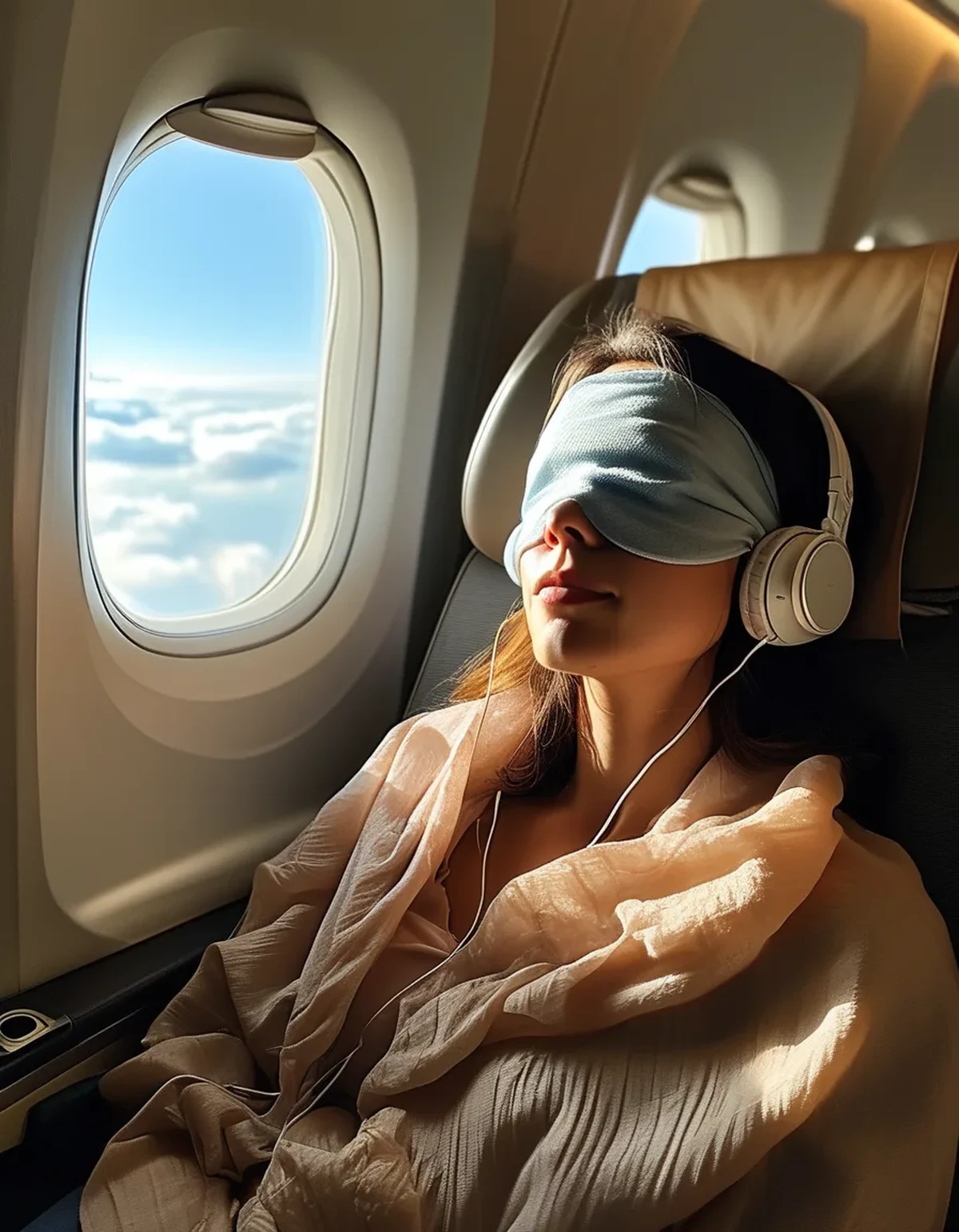
On a plane, that is fine and often the point — a nidra that becomes sleep is still rest, and cabin sleep is rarely deep enough to hurt you.
On landing day it matters more. If you fall asleep during an afternoon session and wake up two hours later, you have taken a nap, not a nidra, and the evening will be harder.
Two practical guards: set an alarm for 5 minutes past the recording length, and practice sitting up slightly reclined rather than fully flat. Both make the transition to sleep less likely without reducing the rest quality much.
If you are chronically exhausted, falling asleep every time is a signal about your baseline sleep, not about your technique. That is worth looking at with a professional. This is general information, not medical advice.
Does it work in a noisy cabin or a strange hotel room?
Better than you would expect, with one adjustment: choose a recording with a voice you already know.
Unfamiliar environments raise baseline vigilance, and part of your attention stays allocated to the room. A familiar guide reduces the amount of processing the practice requires, so more of it lands even when conditions are poor.
Other things that help in transit:
- Noise cancelling on, but volume low — you want the voice just above the floor of the noise
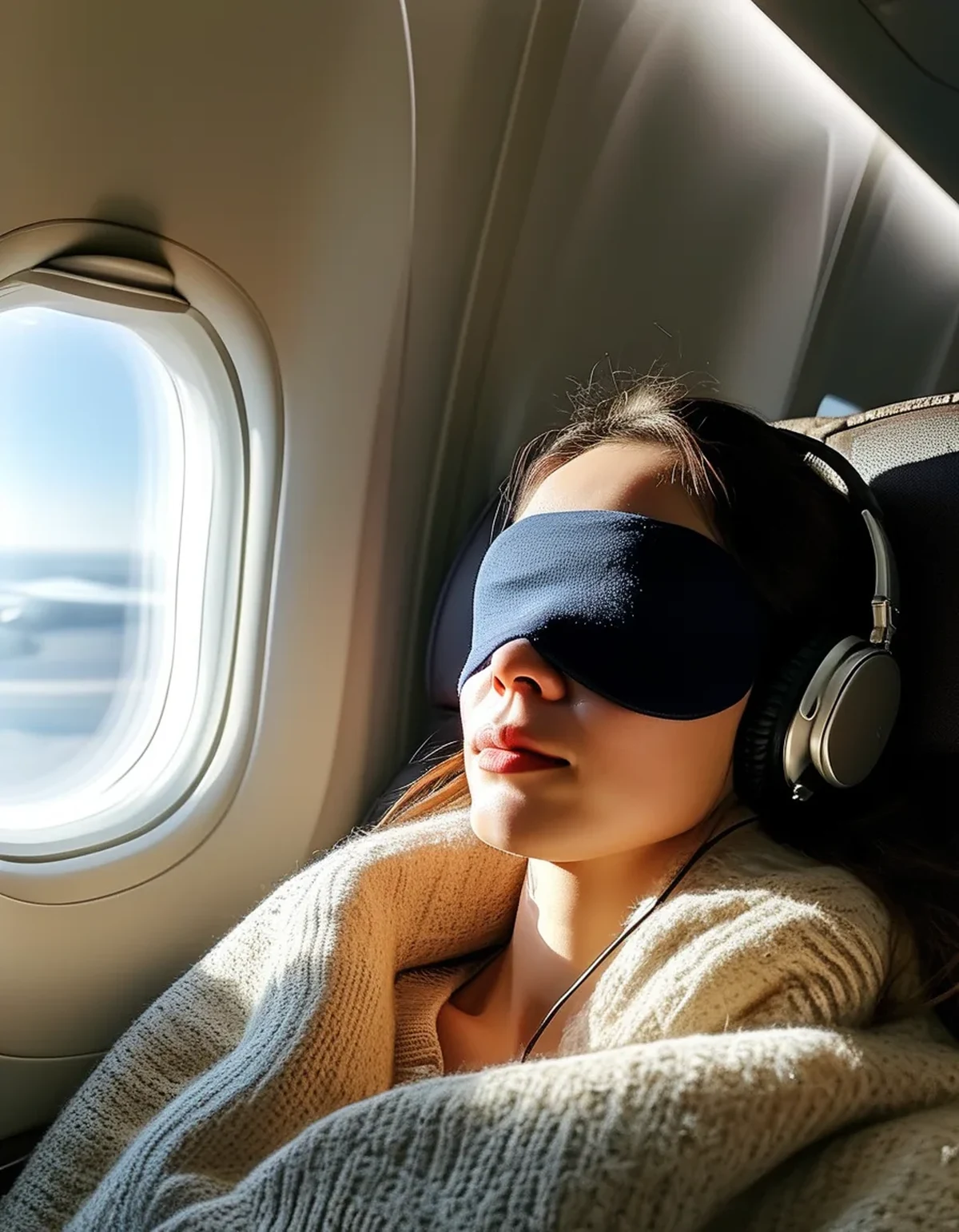
- An eye mask, which does more for practice quality in a bright cabin than any audio choice
- The same practice you use at home, not a special travel one
Novelty is the enemy here. A travel session should be the most boringly familiar thing in your bag.
How does this fit with light exposure and caffeine?
Nidra is one piece of a three-piece system, and it is the least powerful piece.
Light is the primary lever. Get outdoor light in the local morning when traveling east, and in the local late afternoon when traveling west. Fifteen to thirty minutes outdoors beats anything else on this list.
Caffeine is a timing tool, not an energy source. Keep it before local early afternoon and let it do its work during the crash window, then use nidra rather than a second coffee after that.
Nidra covers the gap between those two — the hours when you cannot get useful light, cannot take caffeine, and must not sleep. That is a real and frequent gap on travel days, which is exactly why the practice earns its place.
Stack all three and most people find a westbound trip settles in a day and an eastbound trip in two to three.
FAQ: Travel Practice Questions, Answered
Can I practice yoga nidra during takeoff and landing?
You can rest with eyes closed, but you need to be able to hear crew instructions, so keep one ear free or wait until cruise altitude.
Is nidra better than a normal nap on a travel day?
For a mid-afternoon reset, usually yes, because it delivers rest with less sleep inertia and less erosion of evening sleep pressure. For a genuinely sleep-deprived overnight arrival, a real 90-minute sleep cycle may serve you better.
Does it help with the return trip too?
The return is often harder because home routines resume immediately. Use the same afternoon session for the first two days back, and prioritize morning light.
TL;DR:
- Yoga nidra does not shift your body clock — light timing does — but it makes the behavior that shifts it possible
- Practice on the plane when your body wants sleep at the wrong local time, and mid-afternoon on landing day
- Keep sessions short: 10 to 12 minutes in transit, 20 minutes for the arrival crash, nothing long near local bedtime
- Use a familiar voice and an eye mask; novelty costs you more than cabin noise does
- Stack it with morning light and early-afternoon caffeine cutoffs for the real effect
The practice is not magic across time zones. It is the thing that gets you to 10 PM local, which is where the actual fix happens.
Keep Reading
This article is for general informational purposes only and is not medical advice. Always consult a qualified health professional for guidance specific to you.