Yoga Nidra in Twelve Minutes: Your Questions, Answered
Quick Answer: A twelve-minute session is genuinely useful and clearly better than nothing. You get most of the nervous system down-shift, a real drop in perceived stress, and a usable afternoon reset. What you lose is the deeper end - the long body scan, the drifting hypnagogic phase, and the sense of time distortion that people associate with a full session. Treat short sessions as the frequent default and long ones as an occasional treat, rather than skipping entirely because you cannot do the full version.
The advice always says 30 to 45 minutes. Your window is the gap between two meetings.
The question is whether twelve minutes is a real practice or just lying down.

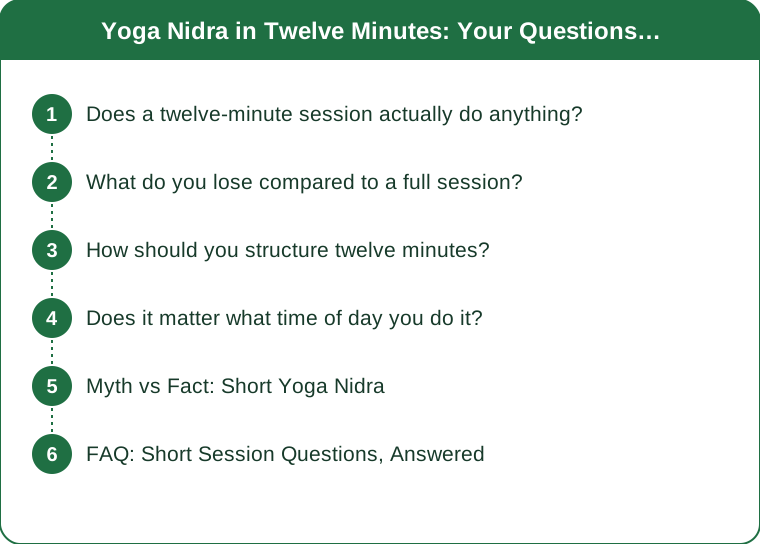
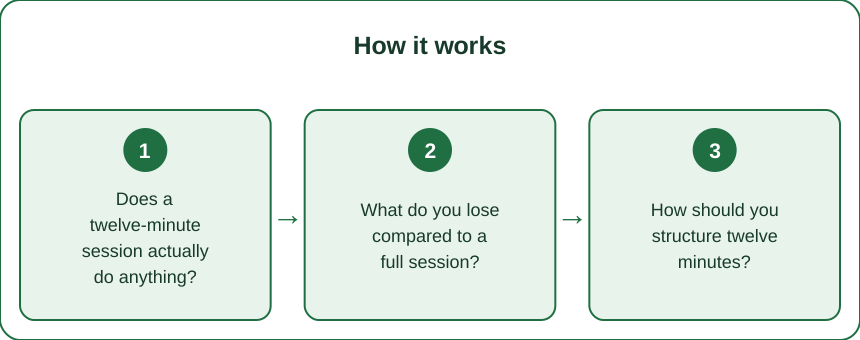
Does a twelve-minute session actually do anything?
Yes, and the shift starts earlier than most people assume. The move toward parasympathetic dominance begins within the first few minutes of settling with slow breathing and stillness.
The body scan is the active ingredient and it compresses well. A rapid scan covering major regions rather than individual fingers still produces the attentional shift the practice depends on.
Perceived stress and mental fatigue drop measurably in short rest sessions, which is the practical benefit most people are actually after in the middle of a working day.
Twelve minutes is long enough to break a rumination loop, which is often the single most useful thing an afternoon session does.
It is short enough to be repeatable, and frequency matters more than session length for anything nervous-system related.
And it fits without negotiation, which is the real reason it works - a practice you actually do beats a better practice you skip.
What do you lose compared to a full session?
The deep drift. The hypnagogic state that people describe as the hallmark of yoga nidra usually needs 20 minutes or more to arrive.
The detailed body scan. Fine-grained attention to individual fingers and facial regions is where a lot of the subtler effect lives, and it does not fit.
Time distortion. The sense of having been somewhere for an hour when it was thirty minutes is a longer-session phenomenon.
The full sankalpa arc, if you use an intention practice, since it wants space at both ends of the session.
Deep muscular release, which unwinds over fifteen to twenty minutes rather than in five.
And the post-session afterglow is shorter, typically an hour or two rather than most of an afternoon.
How should you structure twelve minutes?
One minute settling. Lie down, cushion under the knees, eyes closed, three slow exhales that are longer than the inhales.
Two minutes of breath awareness, counting exhales to occupy the part of the mind that would otherwise start planning.
Five minutes of rapid body scan, moving in large regions - whole right arm, whole left arm, whole right leg - rather than joint by joint.
Three minutes of open resting awareness, no instruction, just remaining still and letting attention be wherever it is.
One minute returning, small movements in the fingers and toes first, then a slow sit rather than standing straight up.
And set a gentle alarm so no part of your attention is monitoring the clock, which is the thing that most reliably prevents the shift.

Does it matter what time of day you do it?
Early afternoon is the natural slot, since the post-lunch dip in alertness is real and a short session lands well in it.
Late afternoon works too and often functions better than caffeine for the last stretch of a working day.
Within two hours of bedtime it may reduce sleep pressure, which is helpful for some people and unhelpful for others - worth testing rather than assuming.
Immediately after eating is harder, since digestion and lying flat combine to make falling fully asleep more likely.
Right after a hard workout it works well, because the body already wants to down-shift and the practice supports it.
And consistency of time helps more than the specific time, since the body learns to anticipate the shift.
Myth vs Fact: Short Yoga Nidra
Myth: anything under 20 minutes is not real yoga nidra.
Fact: traditional practice does run long, and the deepest states do need time. But the physiological down-shift and the attentional reset are available in a much shorter window, and a short session is not a failed long one - it is a different tool with a different purpose.
Myth: falling asleep means you wasted the session.
Fact: in twelve minutes falling asleep is less likely than in forty, but if it happens, a short sleep is not a wasted twelve minutes. It does suggest either genuine sleep debt or that afternoon is too late in your day for it.
Myth: you need an audio guide.
Fact: guided audio helps enormously when you are learning, and after a few weeks most people can run a short scan themselves. Self-guided has the advantage of fitting exactly the time you have rather than the time the recording has.
Myth: short sessions do not help sleep.
Fact: regular short daytime practice tends to help with the nervous system arousal that keeps people awake at night, and the effect is about frequency rather than session length. Timing is the caveat - too close to bedtime it can work against you.
Myth: you have to lie down.
Fact: lying down is best, and a reclined chair or a supported seated position is a legitimate second choice when a floor is not available. Any position you can hold still and comfortably for twelve minutes will do the job.
Myth: twelve minutes is not long enough to bother with a proper setup.
Fact: the setup is what makes the short version work. A cushion under the knees, something over you because body temperature drops, and a phone on do-not-disturb are the difference between twelve useful minutes and twelve minutes of adjusting.
FAQ: Short Session Questions, Answered
Is twelve minutes better than nothing?
Clearly. It captures most of the accessible nervous system benefit and it is repeatable, which matters more than any single long session.
Can I do two short sessions instead of one long one?
Yes, and for daytime stress management that often works better. Two twelve-minute sessions are not identical to one twenty-five minute one, but they are genuinely useful.
Should I set an alarm?
Yes, something gentle. Knowing an alarm will end it is what lets you stop monitoring the time, which is the main obstacle in a short session.
Why do I get cold in twelve minutes?
Core temperature drops quickly once you are still. Cover yourself before you start rather than reaching for something halfway through.
Is this the same as NSDR?
Non-sleep deep rest is a broad term that overlaps heavily with yoga nidra practice, and most short NSDR recordings are structurally a compressed nidra session.
What if I only have five minutes?
Still worth doing. Settle, breathe with long exhales, and do a very fast scan. It will not go deep, but it reliably interrupts the state you were in.
TL;DR:
- Twelve minutes captures most of the nervous system down-shift and the attentional reset.
- What you lose is the deep drift, the fine-grained scan and the time distortion, all of which need twenty minutes or more.
- Structure it as 1 settling, 2 breath, 5 rapid scan, 3 open rest, 1 returning.
- Set a gentle alarm and cover yourself before you start - both are what make the short version work.
- Frequency beats duration, so short and regular is the better default with long sessions as the occasional treat.
The full session is better. The one you actually do is what changes anything.
Keep Reading
This article is for general informational purposes only and is not medical advice. Always consult a qualified health professional for guidance specific to you.