Does Yoga Nidra Still Work if You Fall Asleep? Questions Answered
Quick Answer: Falling asleep during yoga nidra is extremely common and not a failure. You still get the rest, and you miss some of the specific benefits that come from staying in the borderland between waking and sleeping. If it happens every time, it is usually a signal about your sleep debt rather than your practice - and there are simple adjustments that help.
You lie down, the voice starts guiding you through the body, and the next thing you know it is the closing chime and you have no memory of the last twenty minutes.
This is the most common yoga nidra experience there is, and it prompts the same set of questions from nearly everyone. Here they are, answered in order.

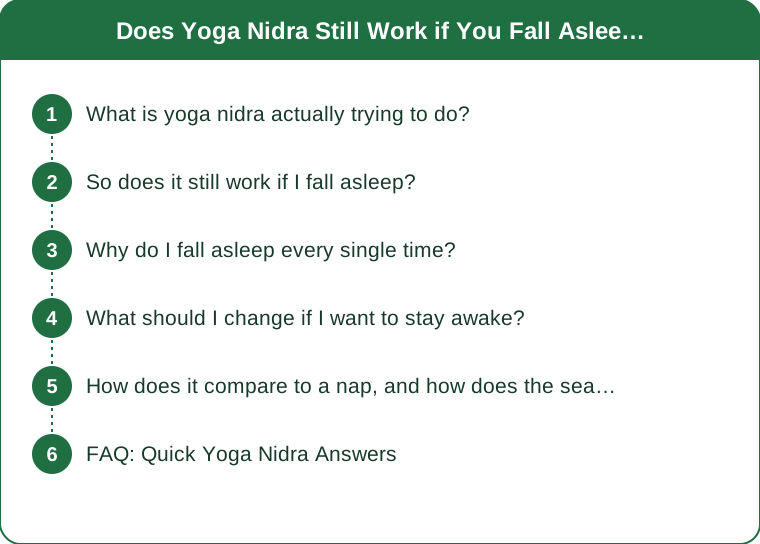
What is yoga nidra actually trying to do?
It is trying to hold you at a specific point on the way to sleep, rather than take you into it.
Yoga nidra guides you into a state where the body is as relaxed as it is in sleep, while a thread of awareness remains. Practitioners describe it as being simultaneously asleep and awake, and it is often called yogic sleep for exactly that reason.
The classic structure is consistent across most traditions. A settling period, an intention, a systematic rotation of awareness through the body, breath awareness, work with sensation or opposites, sometimes imagery, and a gradual return.
The body scan is doing something specific. Moving attention through body parts in a set sequence occupies the mind just enough to prevent thinking, while progressively releasing muscular tension. It is the engine of the practice.
The state itself is what the practice is for. That borderland is associated with deep physical rest, and practitioners consistently report a distinctive quality of restoration - one that many describe as unlike either napping or meditation.
So falling asleep means you passed through the destination rather than staying at it. Which is worth knowing and is not the failure people take it for.
So does it still work if I fall asleep?
Partly, and honestly the answer depends on what you came for.
If you came for rest
Yes. Sleep is restorative, you were deeply relaxed on the way in, and you will wake feeling better. A yoga nidra session you slept through is a well-set-up nap with an excellent wind-down, and that is a genuinely good outcome.
If you came for the specific state
Not really. The particular quality of conscious deep rest requires you to be conscious. If you sleep through every session, you have never actually experienced the thing the practice is designed to produce.
If you came to work with an intention
Probably not. The traditional practice places an intention at a moment when the mind is highly receptive, and being asleep for it means it is not happening.
If you came because you cannot sleep
Falling asleep is the desired outcome. Using yoga nidra as a sleep-onset tool is a legitimate and popular use of it, and for that purpose sleeping through it is success rather than failure.
The most useful framing: decide what you want from a given session and set it up accordingly. The same practice serves both purposes and the setup differs.
Why do I fall asleep every single time?
Usually one of five reasons, and most of them are easy to test.
You are carrying sleep debt
This is the most common answer by a distance. If you are genuinely short on sleep, lying down in a dark quiet room with a calm voice will put you to sleep, every time, regardless of technique. The practice is not failing - it is revealing something.
The time of day
Late evening practice, or the early-afternoon dip when your body clock naturally drops, both make sleep far more likely. Mid-morning or late afternoon are much easier times to stay in the borderland.
The position
Lying flat in bed is the position most strongly associated with sleep, and your body responds accordingly. Practicing on the floor, or semi-reclined with support, keeps you meaningfully more alert.
The room is too warm and too comfortable
A warm room and a duvet is a sleep setup. Slightly cooler, with a light blanket, keeps you present. Autumn is when people start practicing under duvets in warm rooms and start sleeping through every session.
You are new to it
The skill of resting deeply while remaining aware genuinely develops with practice. Most people sleep through their early sessions and gradually find they stay present for more of it over weeks and months.

What should I change if I want to stay awake?
A set of adjustments, in order of how effective they usually are.
Practice at a different time
Mid-morning or late afternoon rather than evening or immediately after lunch. This alone resolves it for a lot of people.
Change your position
On the floor rather than in bed, with a bolster under the knees. Some traditions suggest keeping one arm bent at the elbow with the forearm upright - if you drift off, the arm falls and wakes you. It sounds like a gimmick and it works.
Cool the room slightly
A cooler room with a light cover keeps you present far better than a warm room with a duvet.
Keep your eyes slightly open
A soft, unfocused gaze rather than fully closed eyes. It is harder to maintain and it makes drifting off much less likely.
Address the sleep debt directly
If you are consistently sleeping through, the most useful response might be to get more sleep at night rather than to fight it during practice. The practice is telling you something worth listening to.
And do not treat the drifting as a problem to solve immediately
Many experienced practitioners describe moving in and out of awareness throughout a session, catching fragments and losing others. That is closer to the normal experience than a continuous unbroken thread of awareness, and expecting perfection is a good way to be tense during a relaxation practice.
How does it compare to a nap, and how does the season change it?
Two questions that come up constantly and are worth answering together.
Is it better than a nap?
They are different tools. A nap involves actual sleep with its stages and can leave you groggy if you wake from a deep stage - the well-known post-nap fog. Yoga nidra ideally avoids that by not entering deep sleep, which is why people frequently report feeling clear rather than groggy afterward.
Practitioners often describe twenty minutes of nidra as feeling more restorative than twenty minutes of napping, and the research on this is still developing, so it is fair to say it is a widely reported experience rather than a settled fact.
Does it replace sleep?
No, and any claim that it does should be treated with caution. It is a rest practice, not a sleep substitute, and chronic sleep deprivation is not solved by daytime relaxation.
What changes in autumn and winter?
Several things, and mostly in yoga nidra’s favor. Darker afternoons make daytime practice easier because the room is naturally dimmer. Colder weather means people are indoors more, and a twenty-minute rest practice fits the season well.
And the seasonal energy dip is real for many people. Reduced daylight affects mood and energy, and a regular rest practice is a reasonable, low-cost response. If the seasonal change is affecting your mood substantially rather than mildly, that is worth discussing with a doctor - seasonal mood patterns are common and treatable, and a relaxation practice is a complement rather than a treatment. This is general information and not medical advice.
The practical autumn adjustment: move your practice earlier in the day as the evenings darken, keep the room slightly cooler than feels natural, and use a blanket rather than a duvet.
FAQ: Quick Yoga Nidra Answers
How long should a session be?
Anywhere from ten to forty-five minutes. Twenty to thirty is the most common and a reasonable default. Shorter sessions are genuinely useful and are much easier to do consistently.
Do I need a teacher or is a recording fine?
Recordings are completely fine and are how most people practice. A live class or teacher is valuable for learning the structure and for working with intention, and neither is required to start.
Can I practice lying on my side?
Yes - if lying on your back is uncomfortable, or you are pregnant, a side-lying position with support is perfectly appropriate. The position matters less than being able to stay still comfortably.
Will it help my night-time sleep?
Many people find a regular practice improves sleep onset and quality, likely through reduced arousal before bed. If you have a diagnosed sleep disorder, treat it as a helpful addition alongside proper treatment rather than instead of it.
TL;DR:
- Falling asleep is the most common yoga nidra experience and is not a failure - you still get the rest, but you miss the specific state the practice aims at.
- If you sleep through every session, the usual cause is genuine sleep debt, followed by time of day, position, and a room that is too warm.
- To stay present: practice mid-morning or late afternoon, on the floor rather than in bed, in a slightly cooler room, with a soft open gaze.
- It is a rest practice rather than a sleep substitute, and it typically avoids the grogginess that waking from a deep nap produces.
If you keep falling asleep, the practice is not failing you. It is telling you something about how tired you are.
Keep Reading
This article is for general informational purposes only and is not medical advice. Always consult a qualified health professional for guidance specific to you.