What's Actually Happening in Your Brain During Yoga Nidra?
Quick Answer: Yoga nidra guides the brain into a state associated with theta and delta brainwave activity — patterns typically seen in the transition into sleep — while maintaining a thread of conscious awareness that keeps you from actually falling fully asleep, a combination sometimes called “conscious sleep”; this specific brainwave pattern, distinct from both ordinary wakeful rest and full sleep, is why yoga nidra often produces a felt sense of deep restoration that simply lying down quietly doesn’t reliably deliver.
Describing yoga nidra as “deep relaxation” undersells what’s actually happening. The practice is specifically designed to guide the brain through a sequence of wave states that ordinary resting doesn’t reliably reach.

What brainwave states does yoga nidra actually move you through?
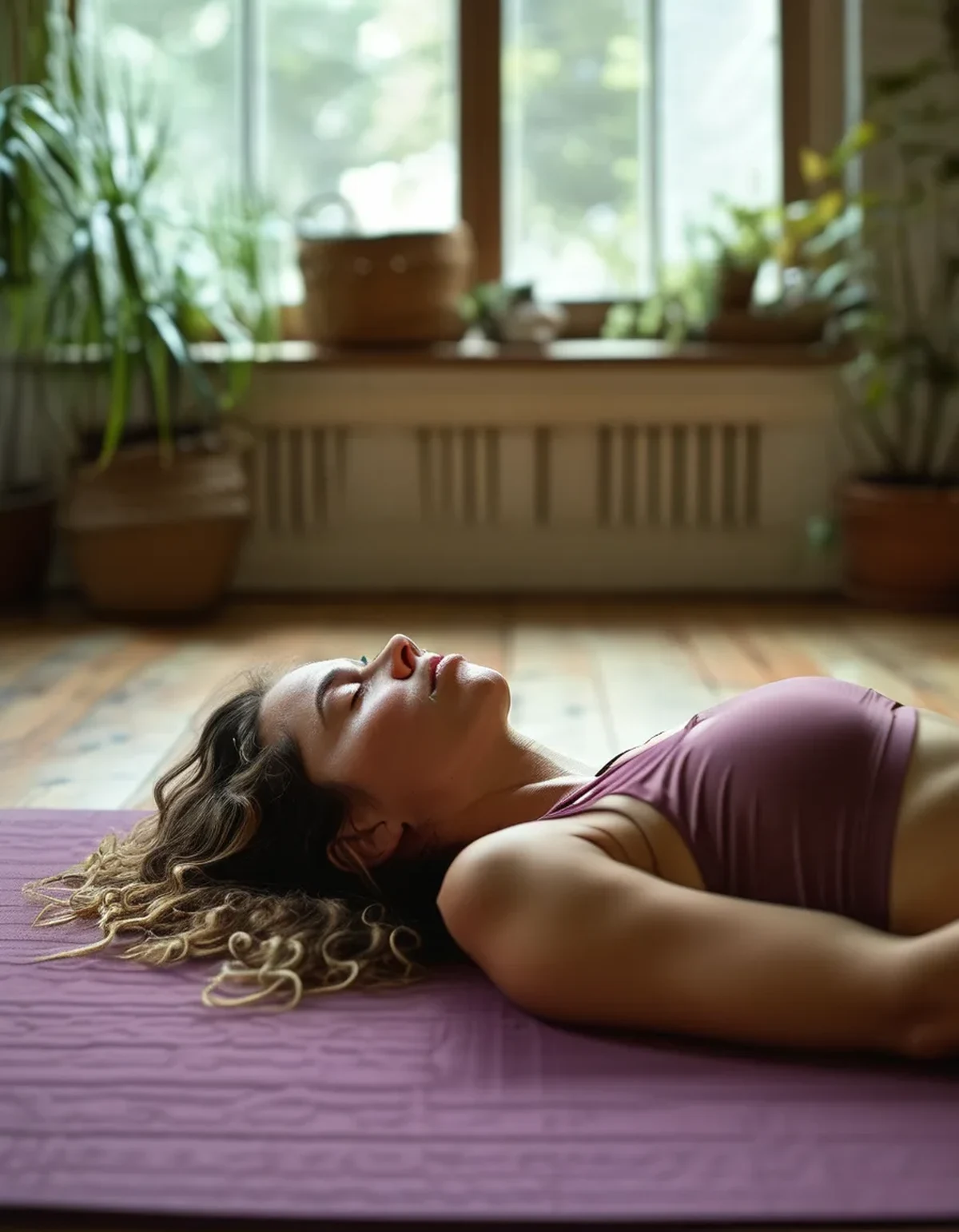
Yoga nidra typically guides practitioners from alpha waves (relaxed wakefulness) toward theta waves (associated with the drowsy transition into sleep, and also deep meditation), and in longer or deeper sessions, sometimes briefly toward delta waves (typically associated with deep, dreamless sleep) — all while a thread of conscious awareness is deliberately maintained through the guide’s voice. This progression through wave states is a large part of why the practice is often described as sitting in the space between waking and sleeping, rather than simply being very relaxed.
How is this actually different from just being very relaxed or nearly asleep?
Ordinary relaxed wakefulness sits mostly in alpha wave activity, without dropping into theta the way yoga nidra guides you to. And unlike actual sleep, where conscious awareness of your surroundings disappears entirely, yoga nidra maintains a specific thread of awareness — you remain aware enough to follow the guide’s instructions even while in a brainwave state closer to early sleep than to normal wakeful rest. That combination of theta-range brain activity plus retained awareness is the specific, somewhat unusual state the practice is built around.
Why does yoga nidra feel so much more restorative than a nap of the same length?
Part of the explanation is that yoga nidra deliberately guides you through this wave-state transition using a structured technique, rather than leaving you to drift unpredictably the way a nap does — a nap might stay shallow the whole time, or might tip into deep sleep and leave you groggy on waking, whereas yoga nidra’s structure aims consistently for the theta-dominant, aware-but-deeply-relaxed zone. Some research also points to yoga nidra reducing cortisol, the primary stress hormone, more consistently than passive rest alone.
Does yoga nidra actually reduce activity in the brain’s stress-response network?
There’s growing evidence that yoga nidra is associated with reduced activity in the amygdala and broader sympathetic nervous system, the brain and body systems most responsible for stress and threat response, alongside increased activity in networks associated with interoception (sensing internal bodily states) and parasympathetic (rest-and-digest) activation. This shift is part of the physiological basis for why the practice is used clinically in some anxiety and PTSD treatment contexts, not just as a general wellness tool.
Why is falling fully asleep during yoga nidra actually considered a partial miss, not success?
Because the practice’s specific value comes from occupying the theta-range state while still consciously tracking the guide’s voice, falling fully into unconscious sleep means you exit that particular zone rather than deepen it. This doesn’t mean falling asleep occasionally is a problem — rest is still valuable — but it does mean the felt experience of “aware but deeply relaxed” is the actual target the technique is built to produce, not sleep itself.
What Nobody Tells You About Yoga Nidra’s Brain Effects
Most descriptions of yoga nidra focus on how relaxed it makes you feel, without mentioning that the technique’s specific brainwave targeting is what distinguishes it mechanistically from simply lying still — this is also why guided audio matters more for yoga nidra than for many other relaxation practices: the structured verbal guidance is part of what reliably steers the brain toward that particular theta-dominant state rather than letting it drift unpredictably.
What does science say about yoga nidra’s effect on sleep quality afterward?
Several small studies have found yoga nidra practiced regularly is associated with improved subjective sleep quality and reduced time to fall asleep at night, potentially related to its cortisol-lowering and parasympathetic-activating effects. It’s generally studied as a complementary practice alongside good sleep hygiene, not a replacement for addressing sleep issues with a healthcare provider if problems are persistent or severe.
FAQ: Yoga Nidra and the Brain, Answered
Is yoga nidra’s brain state similar to meditation, or genuinely different?
There’s real overlap, particularly with theta-wave-focused meditation styles, but yoga nidra’s structured, guided progression through specific body and breath stages is somewhat distinct from open, unguided meditation.
Do EEG studies actually confirm these brainwave claims, or is this mostly anecdotal?
A number of small EEG studies do show measurable shifts toward theta (and sometimes delta) activity during yoga nidra sessions, though sample sizes in this research area are often limited and larger studies would strengthen the evidence.
Does the specific guide’s voice or script affect which brain state you reach?
Somewhat — a slower, more evenly paced guide voice with adequate pauses tends to support the wave-state transition better than a rushed or unevenly paced one, which is part of why guide preference is a genuinely practical factor, not just an aesthetic one.
Can yoga nidra’s brain effects be measured with a consumer wearable, or only in a lab?
Some consumer sleep and meditation wearables now attempt to estimate brainwave-adjacent states via heart rate variability and movement, but this is a rough proxy compared to actual EEG measurement used in research settings.
This is general information about ongoing research, not a clinical or medical claim about any specific health outcome.
TL;DR:
- Yoga nidra guides the brain from alpha toward theta (and sometimes brief delta) wave activity, distinct from both normal rest and full sleep
- The practice deliberately maintains a thread of conscious awareness even in this theta-dominant state — often called “conscious sleep”
- It’s associated with reduced amygdala and sympathetic nervous system activity, alongside increased parasympathetic activation
- Falling fully asleep during the practice means exiting the specific state the technique is designed to produce
The felt sense of deep restoration during yoga nidra isn’t just subjective — it tracks with a measurably distinct brain state that ordinary quiet rest doesn’t reliably reach.
Keep Reading
This article is for general informational purposes only and is not medical advice. Always consult a qualified health professional for guidance specific to you.