Yoga Nidra vs a Nap: Which Afternoon Reset Do You Actually Need?
Quick Answer: A 10-to-20-minute nap delivers real sleep — the strongest fix for a genuine sleep deficit, with sharper memory and alertness on the other side — but it demands the ability to fall asleep on command, carries grogginess risk if it runs long, and taxes night sleep when taken late. Yoga nidra (the practice behind the NSDR trend) delivers deep guided rest with zero sleep required: no inertia, no falling-asleep pressure, usable later in the day, and famously friendly to anxious resters and insomniacs. Sleep-deprived before 3 pm: nap. Wired-but-tired, past 3 pm, or a failed napper: nidra.
One is a deposit into the sleep account. The other is turning the engine off while parked. Different repairs, same parking lot.

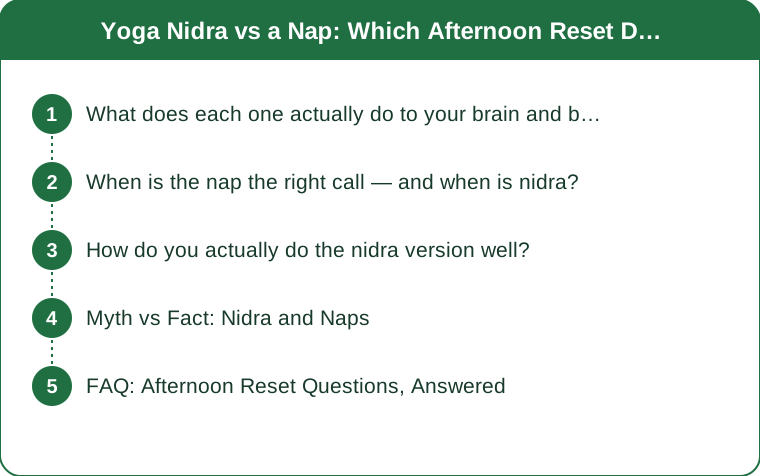
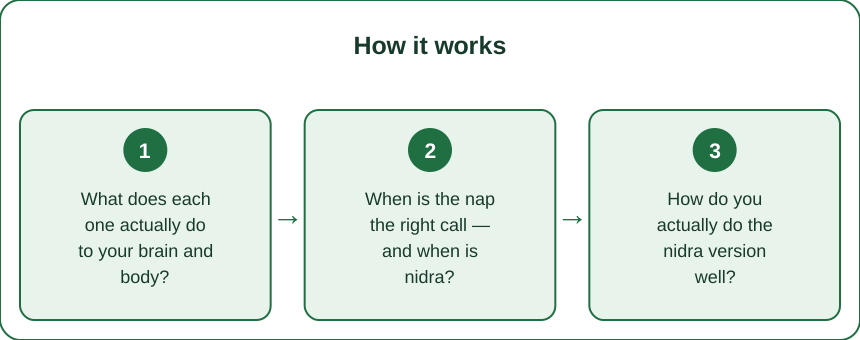
What does each one actually do to your brain and body?
A nap is sleep, with sleep’s mechanics. Nidra is guided deep rest, with waking’s control.
The nap runs the genuine sleep machinery. Ten to twenty minutes of light-stage sleep measurably restores alertness, mood, and short-term memory — the well-documented power-nap effect — and it pays down real sleep pressure, which nothing else on this page does. The mechanics cut both ways: drift past about 20 to 30 minutes and you enter deeper stages, and waking from those delivers sleep inertia — the groggy, worse-than-before fog that can shadow an hour. Naps also spend sleep pressure you will want at 11 pm, which is why the classic guidance caps them early and short.
Yoga nidra keeps you on the waking side of the border, deliberately. Lying completely still, a guided voice walks attention through the body, the breath, and imagery — systematic enough that the mind stays occupied, gentle enough that the body downshifts profoundly. Practitioners hover in a drowsy, deeply relaxed state: rest-and-digest activation, slowed breath and heart rate, the felt sense of having been somewhere very quiet — without crossing into sleep.
What that buys practically: no falling-asleep requirement (the skill that fails exactly when you need it most), essentially no inertia risk, a fixed duration that ends when the track ends, and minimal impact on night sleep — which is why it slots safely into late-afternoon hours where naps are off-limits.
What it does not buy: actual sleep. Nidra restores the feeling and much of the function of rest, and popular claims that a session equals four hours of sleep are marketing, not measurement. A real sleep debt wants real sleep — in a nap or, better, tonight.
When is the nap the right call — and when is nidra?
Route by three questions: Is there a sleep deficit? What time is it? Can you actually fall asleep on command?
Take the nap when:
You are genuinely underslept — short night, early flight, new-parent arithmetic. Nothing substitutes for sleep at repaying sleep; a 15-to-20-minute nap is the strongest tool in the drawer.
It is before roughly 2-to-3 pm, keeping the sleep-pressure spend far from bedtime.
You nap well — out in five minutes, up at the alarm without wreckage. Good nappers are made partly by practice and partly by constitution; if that is you, use the gift.
You have the setup: somewhere to lie that is not your actual bed (beds invite the 90-minute version), an alarm at 20 minutes, and no meeting inside the following ten.
Choose nidra when:
You cannot fall asleep on demand — the person who lies rigid for 20 minutes failing to nap, then rises defeated. Nidra deletes the pass-fail exam; resting is the whole assignment.
It is after 3 pm. The late-afternoon crash window belongs to nidra precisely because it costs tonight nothing.
You are tired-and-wired — exhausted but revving, the post-deadline or pre-event state. Naps bounce off adrenaline; a guided voice gives the racing mind a handrail down.
Grogginess ruins you. Some people wake from any nap worse; for them nidra is simply the better instrument, full stop.
Sleep itself is fragile. For insomnia-prone resters, daytime sleep can loosen nighttime sleep further; nidra delivers daytime restoration without touching the night’s architecture — and a pre-bed session doubles as an on-ramp to sleep rather than a competitor.
The honest hybrid: many experienced resters start a nidra recording and allow a brief drift if it comes — a soft-landing nap with a built-in exit ramp, since the track’s ending stirs you before deep stages consolidate.

How do you actually do the nidra version well?
Ten to twenty guided minutes, flat and warm, with the bar set at showing up.
Pick a guided track and surrender the steering. Nidra is a led practice — search any app or free platform for yoga nidra or NSDR in 10-, 15-, or 20-minute lengths and choose a voice that does not annoy you (a genuinely important criterion; you will hear it many times). The afternoon-reset dose is 10 to 20 minutes; save the 40-minute deep sessions for weekends.
Set up for stillness, horizontally if possible. Flat on your back on a rug, mat, or couch; folded blanket under the head, support under the knees if the low back votes for it. Warmth is non-negotiable — deeply resting bodies cool fast, so a blanket over you and comfortable soft layers beat lying there bracing against chill. Eyes covered or closed, phone on do-not-disturb, headphones in. A chair version — feet flat, hands resting — works fine at an office.
Then follow the voice, and lower the bar to the floor. The instructions are the practice: attention moves where guided, and when your mind wanders — it will, constantly at first — returning to the voice is the rep, not the failure. Drifting near sleep is fine; the guidance is built to loop you back. There is no doing it well, only doing it.
Coming out: slower than the calendar wants. Wiggle fingers and toes, roll to one side, sit for three breaths before rejoining the afternoon. The re-entry minute is where the calm consolidates.
Placement notes: the classic slot is the post-lunch dip, 1-to-3 pm; late-afternoon works too. Directly after lunch, prop the head slightly if reflux comments. And pair it with the boring allies — the after-lunch walk, honest caffeine timing — rather than asking one track to carry a whole ragged schedule.
This is general wellness information, not medical advice. Chronic exhaustion that rest never touches, loud snoring, or dozing through meetings and driving are sleep-medicine conversations, not technique problems.
Myth vs Fact: Nidra and Naps
Myth: One yoga nidra session equals four hours of sleep. Fact: The claim circulates widely and measures nothing. Nidra produces a genuinely restorative waking-rest state, and it does not run sleep’s repair processes or repay sleep debt. Use it as excellent rest — not as a sleep substitute on a chronically short schedule.
Myth: Napping is for the lazy or the elderly. Fact: Brief planned naps are standard practice in aviation, athletics, and medicine precisely because the alertness and performance gains are measurable. The 20-minute nap is a professional tool with a bad publicist.
Myth: If you fall asleep during yoga nidra, it failed. Fact: Drifting is common, expected, and usually a sign the body needed exactly that. The track’s ending provides a soft exit. With practice, most people hover at the drowsy border longer — but sleep is a fine outcome, not a foul.
Myth: Naps work for everyone if you do them right. Fact: Constitution varies: some people reliably wake groggy from any daytime sleep, and insomnia-prone sleepers can pay for naps at night. For both groups nidra is not the consolation prize — it is the correct tool.
Myth: You need training or an app subscription to do NSDR. Fact: Free guided tracks cover every length and style, and the practice asks nothing but lying still and listening. The entire startup cost is a blanket and headphones you already own.
FAQ: Afternoon Reset Questions, Answered
Which is better for the 2 pm crash before a big meeting?
With 30 minutes and good napping skills before mid-afternoon: a 15-minute nap, alarm set, plus a 10-minute buffer to shake it off. With 20 minutes, shaky napping skills, or a late slot: a 15-minute nidra track — zero grogginess risk is worth a lot right before performing.
Can yoga nidra replace sleep if my nights are short?
No — it restores alertness and calm impressively, and only sleep repays sleep. Use nidra to survive the afternoon, and spend the real effort on the night: earlier wind-down, caffeine cutoff, consistent wake time.
How often can I use each?
Daily nidra is fine — many practitioners treat it like brushing teeth. Naps are also fine daily if they stay short, early, and do not erode night sleep; if nights start fraying, the nap is the first thing to trim.
I fell asleep during my last three nidra sessions — should I switch to naps?
Maybe, or sit up slightly, practice earlier, or shorten the track — persistent sleep during nidra usually reports an unpaid sleep debt. Take the hint at night first; the practice gets more interesting once you can stay at the border awake.
TL;DR:
- Naps are real sleep: the strongest fix for real sleep deficits — best at 10 to 20 minutes, before 3 pm, for people who can actually fall asleep on cue.
- Yoga nidra is guided deep rest with no sleep required: no grogginess, no falling-asleep exam, safe late in the day, kind to insomniacs.
- Route honestly: underslept and early — nap; wired, late, or nap-incapable — nidra. The four-hours-of-sleep claim is marketing.
- Do nidra flat, warm, and guided, 10 to 20 minutes, with wandering-and-returning counted as the practice itself.
Download one 15-minute nidra track now and file it under Tuesday, 2 pm. The next crash has an appointment waiting.
Keep Reading
This article is for general informational purposes only and is not medical advice. Always consult a qualified health professional for guidance specific to you.