Yoga Nidra on a Shift Schedule: Questions From People Who Sleep at Odd Hours
Quick Answer: Yoga nidra suits shift work unusually well because it does not require darkness, a particular time of day, or actually falling asleep - all the things a shift schedule takes away. It will not replace lost sleep, but 20 to 30 minutes produces meaningful restoration and is far more reliably achievable than a daytime nap. Use it before a daytime sleep to help you settle, mid-shift for a reset, and after a night shift when you are too wired to sleep. The practice is the same; the timing logic is what changes.

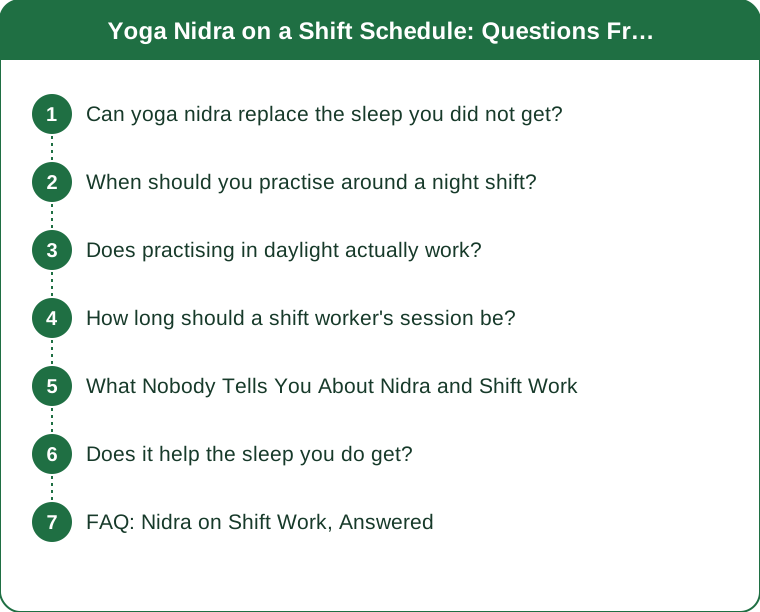
Can yoga nidra replace the sleep you did not get?
No - and any source claiming otherwise is overselling it. Sleep does things nidra does not replicate, particularly the memory consolidation and physical repair tied to specific sleep stages.
What it does provide is genuine restoration. A 20 to 30 minute session leaves most people measurably calmer and more functional, which is a real benefit even though it is not equivalent to sleep.
Its main advantage for shift workers is reliability. A daytime nap often fails entirely when your body clock is fighting you. Nidra works whether or not you fall asleep, so the session is never wasted.
It also removes the pressure that prevents napping. Lying down trying to sleep creates the exact arousal that stops it happening. Nidra gives you a task, and the task is not sleeping.
And the accumulated deficit still matters. Chronic sleep debt from shift work has real health consequences, and nidra is a coping tool alongside good sleep hygiene rather than a substitute for either.
When should you practise around a night shift?
After the shift, before your daytime sleep, is the highest-value slot. Finishing at 7am usually leaves you wired rather than sleepy, and 20 minutes of nidra bridges that gap far better than lying in the dark willing it to happen.
Mid-shift, during a break, is the second. 15 to 20 minutes around the 3am to 4am low point takes the edge off the worst part of the night without the grogginess a real nap can leave.
Before a night shift, treat it as a top-up. A short session before leaving helps if your daytime sleep was poor, which on a rotating schedule is most of the time.
On changeover days, use it to bridge. The transition between night and day rotations is the hardest part of shift work, and a session at the point where you would otherwise crash helps you hold the new schedule.
Avoid a long session in the last hour before you need to be sharp. Some people come out of a 45 minute session groggy, so keep pre-shift practice to 20 minutes.
And practise on days off too. Consistency makes the practice more effective when you need it, and it stops nidra becoming something you only associate with exhaustion.
Does practising in daylight actually work?
Yes, and this is the practical advantage over napping. Nidra relies on guided attention rather than on darkness, so a bright afternoon does not prevent it the way it prevents sleep.
An eye mask closes most of the gap. It is the single most useful piece of equipment for a shift worker, and it costs very little.
Light still matters for your body clock, separately. If your goal is sleeping afterwards, dim the light and wear sunglasses on the way home - that is circadian management, not nidra practice.
Noise is usually the bigger daytime problem. Household and street sound at 10am is a different environment from 2am. Earplugs or a fan handles most of it.
And do not wait for perfect conditions. A session in an imperfectly dark, mildly noisy room is enormously better than a skipped one, and shift work rarely offers anything better.

How long should a shift worker’s session be?
20 to 30 minutes is the sweet spot for post-shift and pre-sleep use. Long enough for real settling, short enough to fit a genuine break or the window before daytime sleep.
10 to 15 minutes works mid-shift. The goal there is a reset rather than deep restoration, and short sessions leave less grogginess before returning to work.
45 minutes or more is for days off. It is the most restorative length and also the most likely to leave you slow afterwards, so schedule it where that does not matter.
Length matters less than frequency. Five short sessions a week beats one long one, and on a shift pattern the short ones are the ones that actually happen.
And keep a 10 minute version bookmarked for the nights that fall apart. Having a short option ready is what keeps the practice alive through a bad rotation.
What Nobody Tells You About Nidra and Shift Work
Falling asleep during the session is fine, and after a night shift it is likely. If you have sleep to catch up on, your body will take it. That is a successful outcome, not a failed practice.
The first few sessions may feel like nothing. Settling into nidra is a skill that takes three or four attempts, and shift workers usually try it at their most exhausted, which is the hardest starting point.
It can surface how tired you actually are. Stopping for twenty minutes removes the stimulation that has been masking fatigue, and that can be uncomfortable. It is information rather than a setback.
Do not practise while driving home. Ever. This should not need saying, and yet the post-shift drive is precisely when people are tempted by an audio session. Pull over and sleep, or do the session before you leave.
Consistency of place helps more than consistency of time. Shift work removes any hope of a regular hour, but the same room, same mat, same audio builds the association anyway.
And it stacks well with a short caffeine nap. Caffeine, then a 20 minute session, and the caffeine arrives as you finish - useful before the drive home, unhelpful before daytime sleep.
Does it help the sleep you do get?
Yes, mostly by reducing the arousal that delays sleep onset. The commonest shift worker complaint is being exhausted and unable to sleep, and nidra directly addresses that state.
It gives you something to do with the wired hour. Instead of scrolling and getting more alert, you have a structured wind-down that reliably lowers arousal.
It reduces the anxiety loop about sleep itself. Knowing you have a fallback that works even if sleep does not come removes much of the pressure that keeps people awake.
It does not fix your circadian rhythm. That needs light management, consistent sleep windows where possible, and sensible caffeine timing. Nidra is the wind-down, not the clock.
And the effects compound over weeks. People who practise consistently through a rotation report falling asleep faster and waking less than in previous rotations - which is the realistic version of what this offers.
FAQ: Nidra on Shift Work, Answered
Can yoga nidra replace sleep?
No. It provides real restoration and works reliably when napping fails, but it does not replicate the memory consolidation and repair of actual sleep. Treat it as a supplement.
When is the best time to practise on a night shift?
After the shift and before your daytime sleep is the highest value slot, because that wired-but-exhausted hour is where it helps most. Mid-shift around 3am to 4am is second.
Does it work in daylight?
Yes - it depends on guided attention rather than darkness. An eye mask closes most of the gap, and earplugs handle the daytime noise that is usually the bigger issue.
How long should a session be?
20 to 30 minutes post-shift, 10 to 15 mid-shift, 45 or more on days off. Frequency matters more than length.
Is it bad if I fall asleep during it?
No. After a night shift it is likely and it means your body took sleep it needed. The session still counts.
Will it fix my body clock?
No. Circadian adjustment needs light management, consistent sleep windows, and caffeine timing. Nidra is the wind-down tool alongside those.
Can I do it before driving home?
Do it before you leave, never while driving, and never as a substitute for pulling over if you are too tired to drive safely. Persistent severe fatigue or sleep problems on shift work are worth discussing with a doctor - this is general information, not medical advice.
TL;DR:
- Nidra suits shift work because it needs no darkness, no fixed hour, and no actual sleep - it works whether or not you drop off.
- It supplements sleep, it does not replace it. Real restoration, not memory consolidation.
- Best slot: after the shift, before daytime sleep, when you are wired but exhausted.
- 20 to 30 minutes post-shift, 10 to 15 mid-shift, 45+ on days off. Frequency beats length.
- An eye mask and earplugs are the two pieces of equipment worth owning.
- Falling asleep during it is a success, not a failure.
- Consistency of place beats consistency of time when your hours refuse to hold still.
- Never as a substitute for pulling over when too tired to drive.
Persistent severe fatigue on shift work is worth raising with a doctor. This is general information, not medical advice.
Keep Reading
This article is for general informational purposes only and is not medical advice. Always consult a qualified health professional for guidance specific to you.