Can You Do Yoga Nidra With Someone Else in the Room?
Quick Answer: Yes, and it works better than most people expect once you stop treating external sound as an interruption. Yoga nidra does not require silence; it requires that you stay in the practice when something happens. Predictable presence — a partner reading, a sleeping pet — is far easier to accommodate than unpredictable interruption, so the useful adjustments are about reducing surprise rather than reducing noise.

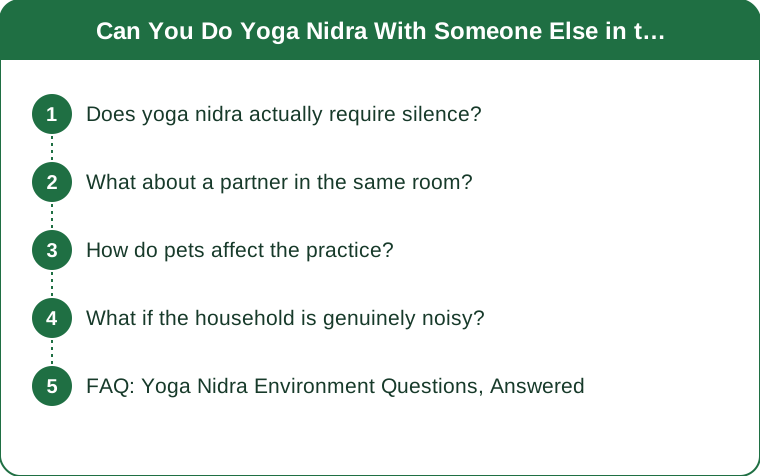
Does yoga nidra actually require silence?
No, and the assumption that it does keeps a lot of people from practising at all.
The practice is a structured attention exercise, not a sensory deprivation exercise. The guided rotation of consciousness through the body works regardless of what the room is doing.
Traditional practice was rarely silent. Nidra has been taught in halls full of other practitioners, with all the breathing, shifting and coughing that implies.
Sound only breaks the practice if you follow it. Hearing a car outside is fine; constructing a story about the car is what pulls you out.
Which is a skill the practice explicitly builds. Noticing that attention has wandered and returning it is the mechanism, not a failure of it.
Predictability matters far more than volume. Steady traffic noise is easy to accommodate; a door slamming once is much harder, because it is a surprise.
And expectation does a lot of the work. If you have decided the room must be silent, every sound is a violation. If you have decided sounds will happen, they are just part of the session.
What about a partner in the same room?
Easier than most people assume, provided you agree the terms first.
Their presence is predictable, which is the important quality. A person sitting quietly reading produces sound you can anticipate and stop attending to within a minute or two.
Agree explicitly on no conversation. The single most disruptive thing is being spoken to, even briefly, because responding requires leaving the practice entirely.
Position matters. Lying with your head away from them reduces the tendency to track their movement, which happens even with your eyes closed.
Self-consciousness is the real obstacle, not the noise. Being observed while lying still is uncomfortable at first for a lot of people, and it fades after a few sessions.
Practising together works well. Two people doing nidra in the same room is easier than one practising and one not, because there is no observer.
And do not negotiate mid-session. Sorting out the arrangement beforehand — where you will be, for how long, whether they can move around — removes the need to think about any of it once you have started.

How do pets affect the practice?
They are the least controllable variable and often the least disruptive one.
A settled pet is genuinely calming. A cat or dog sleeping nearby adds a steady, predictable presence that most people find supportive rather than distracting.
An unsettled one is a different matter. Walking on your chest, pawing at your face, or deciding that a still human is an invitation to play will end a session.
Timing helps more than training. Practise after they have been fed and walked, when they are most likely to settle.
Give them a designated spot in the room. A bed or blanket nearby often satisfies the desire to be near you without involving your torso.
Closing the door is a reasonable option and often produces more disruption than it prevents, in the form of scratching and vocalising. An open door with a settled pet is usually quieter.
And accept a certain amount. A cat that arrives halfway through and settles on your legs is not a failed practice. Noticing it, accepting it, and returning to the guidance is precisely the exercise.
What if the household is genuinely noisy?
Work with the noise floor rather than against it.
Choose the quietest window, not the most convenient one. Fifteen minutes before the household wakes is worth more than forty-five minutes in the middle of the evening.
Use headphones. Guided nidra through headphones raises the guidance above the ambient noise without needing the room to be quiet, and it is the single most effective adjustment available.
Choose a recording with a steady voice and minimal music. Dynamic music means turning the volume up for quiet passages and being startled by loud ones, which is the opposite of what you need.
Tell people what you are doing and for how long. Most household interruptions are avoidable once other people know there is a window in which you would rather not be disturbed.
Accept a shorter practice. Twenty minutes reliably beats forty-five minutes attempted and abandoned, and short nidra recordings are widely available.
And let predictable noise become part of the environment. Traffic, a dishwasher, a neighbour’s television — these become background within a couple of minutes if you stop treating each one as an event.
One practical note: if you regularly fall asleep during nidra in a noisy house, that is usually a sleep debt signal rather than a practice problem. It is not a failure, and it does mean the practice is being used for rest rather than for what nidra is specifically for.
FAQ: Yoga Nidra Environment Questions, Answered
Do I need a silent room for yoga nidra?
No. The practice trains attention rather than requiring the absence of stimuli, and it has traditionally been taught in halls full of people. Predictability matters more than volume — steady background sound is easy to accommodate, sudden unexpected sound is harder.
Can my partner be in the room while I practise?
Yes, provided you agree beforehand that there will be no conversation and they will not need anything from you. Their predictable presence is much easier to accommodate than an unpredictable interruption. Practising together is easier still, since nobody is observing.
What if my cat or dog interrupts?
Usually it is fine. A settled pet nearby is a steady presence most people find supportive. Practise after they have been fed and exercised, give them a bed in the room, and treat an arriving pet as something to notice and return from rather than as a ruined session.
TL;DR:
- Yoga nidra does not require silence. It requires that you return when attention wanders, which is the practice itself.
- Predictable presence is easy to accommodate; unexpected interruption is what actually breaks a session.
- Agree the terms with a partner beforehand — especially no conversation — and practise together if you can.
- Headphones and a steady-voiced recording solve most noisy-household problems.
Waiting for a silent room means waiting indefinitely. Practise in the room you have.
Keep Reading
This article is for general informational purposes only and is not medical advice. Always consult a qualified health professional for guidance specific to you.