Yoga Nidra With a Headache: What Helps, What Makes It Worse, and When to Stop
Quick Answer: For tension-type headaches, yoga nidra is often genuinely helpful — it reduces muscle tension in the neck, jaw, and shoulders and downregulates the stress response that drives them. For migraine, it is more individual: lying still in a dark quiet room aligns well with what migraine needs, and some people find sustained attention on body sensation increases their awareness of the pain. Keep sessions short, use audio at low volume, and stop if focusing on the head area intensifies things.
Skip the head in the body scan. That one modification changes everything.

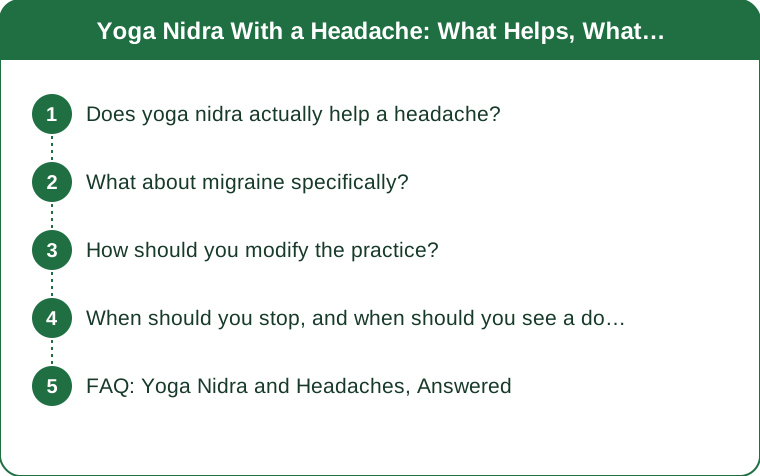
Does yoga nidra actually help a headache?
For the common kind, usually yes. The mechanism is straightforward.
Tension-type headache is the most common headache and is associated with muscle tension in the neck, shoulders, and jaw, along with stress.
Yoga nidra shifts you toward parasympathetic dominance. Extended guided relaxation is associated with lowered arousal, and relaxation-based approaches have reasonable evidence for tension-type headache as part of a broader management approach.
The body scan addresses the specific muscles involved. Systematic attention to jaw, neck, and shoulders often produces noticeable release in exactly the areas that generate tension headaches — and most people have no idea how much tension they carry there until they are asked to notice.
The position helps too. Lying supine with the neck supported removes the postural load that a day of screen work has been placing on the neck extensors.
And it addresses the driver. Stress is a common trigger, and anything that genuinely reduces stress arousal works upstream of the headache rather than just on the symptom.
For migraine, the picture is different. Migraine is a neurological condition, not a muscle tension problem, and it typically involves sensitivity to light and sound, nausea, and pain that is often one-sided and throbbing.
Will it get rid of my headache?
Sometimes, particularly for mild tension-type headaches caught early. More often it reduces the intensity and the surrounding tension rather than eliminating it.
Is it better than lying down quietly?
For tension headaches, the guided body scan does something lying quietly does not — it actively finds and releases held tension. For migraine, the difference is smaller.
What about migraine specifically?
The environment suits it. The practice needs modifying.
Dark, quiet, and still is standard migraine advice, and it is exactly what a yoga nidra setup provides. On that basis alone the environment is well matched.
But the audio is the complication. Sound sensitivity is a common migraine feature, and a guided voice, even a gentle one, may be unwelcome during an attack. Very low volume, or silence, is worth trying.
Attention to the head can go either way. Some people find that observing sensation without resistance reduces the distress around the pain. Others find that directing attention to the head intensifies their awareness of it, which makes things worse.
The modification is simple: skip the head in the body scan. Move through the body normally and leave the head, face, and jaw until the end, or omit them entirely. For many people this single change makes the practice usable during a migraine.
Timing matters. Some people find relaxation practices more useful in the prodrome — the hours before an attack — than during it, and more useful still as a regular preventive practice between attacks.
Regular practice may be more valuable than acute use. Stress is among the most commonly reported migraine triggers, and consistent relaxation practice targets that pattern rather than an individual attack.
Can yoga nidra trigger a migraine?
It is not a known trigger. Some people are sensitive to relaxation-related drops in arousal, and if you consistently notice attacks after practice, that is worth mentioning to your doctor.
Should I practise during an attack or wait?
Try it and judge. If lying in the dark helps you generally, a very quiet, short, head-free session is worth attempting. If concentrating on anything is unbearable, rest is fine on its own.

How should you modify the practice?
Shorter, quieter, darker, and without the head.
Keep it short. Ten to twenty minutes rather than forty. Sustained attention is harder with pain, and a short completed practice beats a long abandoned one.
Lower the volume considerably, and choose a recording with a calm, even voice and no music. Music with dynamic changes is a poor choice when sound sensitive.
Use an eye pillow or a folded cloth over the eyes, and gentle weight over the eyes is soothing for many people. Skip it if any pressure on the face is uncomfortable.
Support the neck properly. A small rolled towel under the neck curve rather than a thick pillow under the head, which pushes the chin toward the chest and adds tension.
Support the knees. A bolster under the knees reduces low back tension and helps the whole body settle.
Keep warm. Body temperature drops during extended stillness, and being cold prevents anything from releasing. A blanket, always — and more of one as autumn arrives.
Skip or shorten the head section, as above.
Choose recordings without breath manipulation. Some practices include breath retention or counting, and altered breathing patterns can aggravate headaches in some people. Simple observation of natural breathing is safer.
Do not force stillness. If you need to shift position, shift. Rigidly holding still against discomfort creates tension, which is the opposite of the goal.
When should you stop, and when should you see a doctor?
Some headaches are not a relaxation problem, and a few are emergencies.
Stop the practice if: the pain intensifies noticeably during it, you feel nauseated or dizzy, focusing on the head makes things clearly worse, or you feel more agitated rather than calmer. None of these mean you did it wrong, and pushing through is not useful.
Seek emergency medical care immediately for: a sudden severe headache that reaches maximum intensity within seconds or minutes, headache with fever and a stiff neck, headache with confusion, weakness, difficulty speaking, or vision loss, headache after a head injury, or the worst headache of your life. These require urgent assessment and no relaxation practice is appropriate.
See a doctor promptly if: your headache pattern changes, headaches become more frequent or severe, they wake you from sleep, they are worse on coughing or bending, or they start after age 50. A new pattern is the thing that matters most.
Also see someone if you are using pain relief frequently. Medication overuse headache is a real and common phenomenon where regular painkiller use itself perpetuates headaches, and it needs proper management.
Yoga nidra is a complement, not a treatment. Frequent headaches deserve a diagnosis, and effective preventive treatments exist for both migraine and chronic tension-type headache.
Keep a simple record. Noting when headaches occur, what preceded them, and what helped is genuinely useful to a doctor and to you. Sleep, hydration, screen time, posture, and stress are the usual suspects, and autumn brings its own additions — darker mornings, more screen time indoors, heating-dried air, and schedule changes.
This is general information, not medical advice. Anyone with frequent, severe, or changing headaches should be assessed by a qualified healthcare professional.
FAQ: Yoga Nidra and Headaches, Answered
Can yoga nidra cure my headaches?
No. It can help manage tension-type headaches and the stress that drives them, and frequent headaches need a proper diagnosis and treatment plan from a doctor.
Should I include the head in the body scan?
Often not, if you have a headache. Skipping the head, face, and jaw sections is the single most useful modification, since directing attention there can intensify awareness of the pain.
How long should a session be when I have a headache?
Ten to twenty minutes. Sustained attention is harder with pain, and a short completed session is worth more than a long one you abandon.
When is a headache an emergency?
Sudden severe onset within seconds or minutes, headache with fever and a stiff neck, headache with confusion, weakness, speech difficulty or vision loss, or headache after a head injury. Seek urgent medical care.
TL;DR:
- For tension-type headaches, yoga nidra helps by releasing neck, jaw, and shoulder tension and lowering stress arousal.
- For migraine, the dark quiet stillness suits it well, and attention on the head can worsen things — so skip that section.
- Keep it short, quiet, warm, and well supported, and avoid recordings with breath retention.
- Sudden severe headache, fever with a stiff neck, neurological symptoms, or headache after injury need emergency care, not a practice.
Try a fifteen-minute session that skips the head entirely. If the practice is going to help, that version is the one that will.
Keep Reading
This article is for general informational purposes only and is not medical advice. Always consult a qualified health professional for guidance specific to you.