Yoga Nidra Body Scan Questions: What's Actually Supposed to Happen When Attention Drifts
Quick Answer: Attention drifting away from the body scan during yoga nidra is not a sign of doing the practice wrong — it’s an expected, normal part of the process, and the instruction to gently return attention to the guide’s voice each time it wanders is itself part of the practice, not a correction for a mistake.
Many newer practitioners assume losing track of the body scan means they’re failing at yoga nidra, when drifting attention and returning to it repeatedly is actually built into how the practice works.

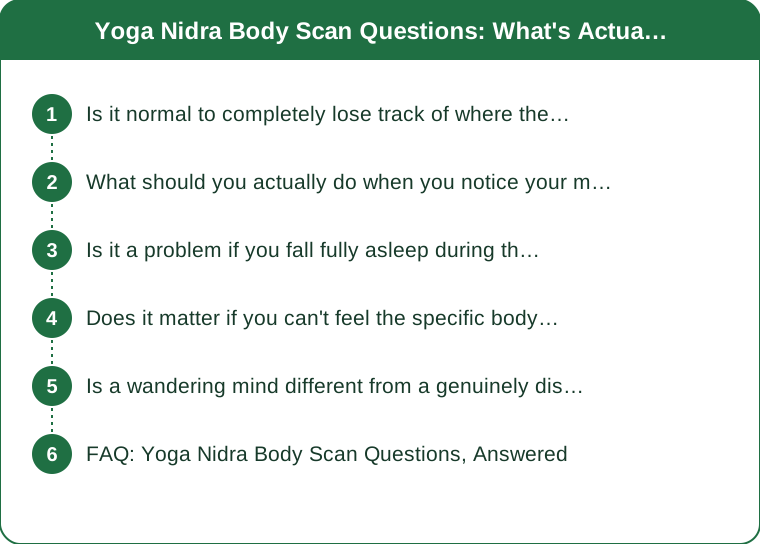
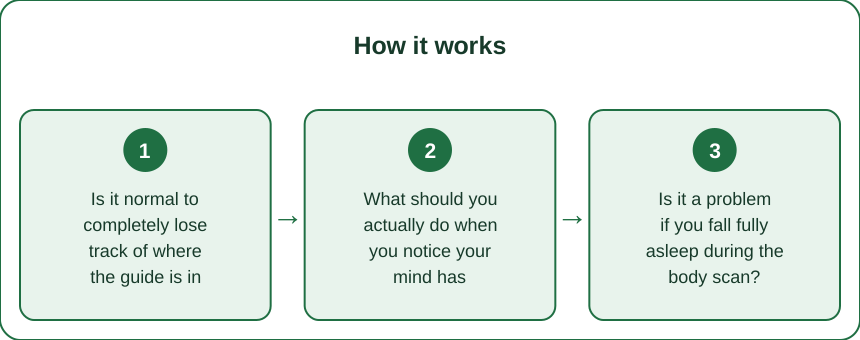
Is it normal to completely lose track of where the guide is in the body scan?
Yes, and it happens to experienced practitioners too — the state yoga nidra encourages (between waking and sleep) naturally makes sustained linear attention difficult, so losing the thread of the guide’s voice partway through, then picking back up later or drifting into a lighter sleep state, is a well-recognized and expected part of the practice rather than a sign of doing it incorrectly.
What should you actually do when you notice your mind has wandered?
Gently redirect attention back to the guide’s voice or the current body part being mentioned, without judgment or frustration about having drifted — this redirect itself, repeated as many times as needed throughout a session, is part of the practice’s actual mechanism, not a failure state requiring correction or extra effort to prevent.
Is it a problem if you fall fully asleep during the body scan?
Falling asleep is common and not considered a failure, though it does mean missing some of the practice’s specific benefits tied to staying in that liminal waking-sleeping state. If falling asleep happens consistently, practicing at a different time of day when you’re less fatigued, or sitting in a more upright supported position, can help maintain the in-between state more of the session.

Does it matter if you can’t feel the specific body part being mentioned?
No — simply directing attention to where a body part is, even without a strong physical sensation there, still engages the practice’s intended mechanism. Many people report weak or no sensation in certain body areas during a scan, and this is considered a normal individual variation rather than something to troubleshoot or worry about.
Is a wandering mind different from a genuinely distracted, agitated mind?
Yes, and it’s worth distinguishing the two — a mind that drifts into drowsy, dreamlike tangents is the expected yin nidra experience, while a mind that’s actively anxious or agitated throughout suggests the environment or timing (right after a stressful event, in a noisy space) may not be well-suited for that particular session, and adjusting conditions rather than pushing through may help more.
FAQ: Yoga Nidra Body Scan Questions, Answered
Should you try harder to stay focused as you get more experienced with yoga nidra?
Not exactly — experienced practitioners generally report drifting and returning becomes a more effortless, less frustrating cycle over time, rather than achieving a state of never drifting at all.
Does time of day change how much attention drift happens?
Yes — practicing when already quite fatigued (very late at night) tends to increase full sleep onset rather than sustained light drifting, so a moderately alert time of day may preserve more of the practice’s distinct in-between state.
Is guided yoga nidra more prone to attention drift than a self-directed body scan?
Guided sessions generally help reduce drift compared to fully self-directed practice, since the ongoing voice provides a consistent anchor to return attention to, which is part of why most yoga nidra is taught in guided form.
TL;DR:
- Attention drifting during a yoga nidra body scan is normal and expected, not a sign of doing it wrong
- Gently returning focus to the guide’s voice, as many times as needed, is part of the practice itself
- Falling fully asleep is common though it does mean missing some of the practice’s specific benefits
- Weak or absent sensation in a body part during the scan is a normal individual variation, not a problem
Treat drifting and returning as the actual mechanism of yoga nidra, not a distraction to eliminate through more effort.
Keep Reading
This article is for general informational purposes only and is not medical advice. Always consult a qualified health professional for guidance specific to you.