Why You Completely Lose Track of Time During Yoga Nidra
Quick Answer: Yoga nidra guides the brain toward theta and delta wave patterns typically associated with early sleep stages, and time perception relies partly on the same brain regions involved in normal waking attention — which is why a 30-minute session can genuinely feel like it lasted only a few minutes once it ends.
The session felt like it lasted maybe ten minutes. The timer says thirty. This isn’t a fluke or a sign you drifted off completely — it’s a known effect of the specific brain state yoga nidra is designed to access.

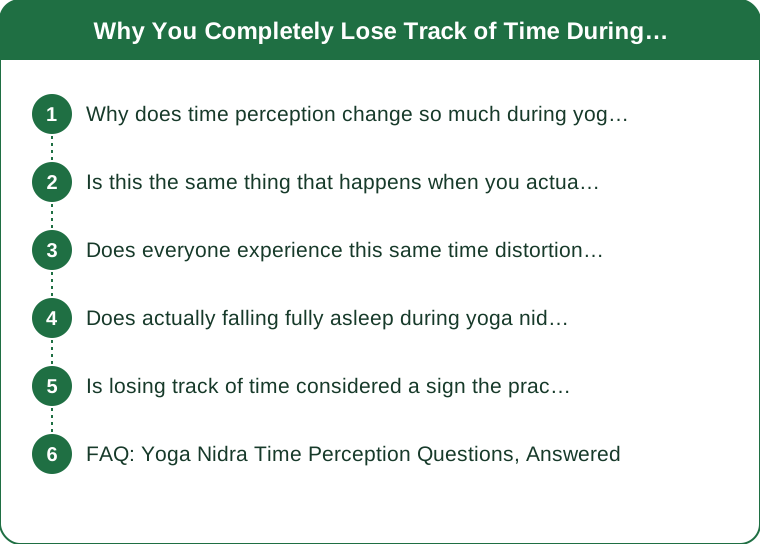
Why does time perception change so much during yoga nidra specifically?
Time perception relies partly on continuous attentional processing, and yoga nidra deliberately guides the brain away from typical waking attention patterns toward theta and sometimes delta brainwave states more associated with the early stages of sleep — states where the brain’s normal time-tracking processes function differently than they do while fully awake and alert.
Is this the same thing that happens when you actually fall asleep?
It’s related but distinct — yoga nidra aims for a conscious, aware state even while brainwave patterns resemble early sleep stages, sometimes described as being “asleep” to the body while the mind stays subtly aware. This partial-awareness state is part of what creates such a distorted, compressed sense of elapsed time.
Does everyone experience this same time distortion, or does it vary a lot?
It varies meaningfully — some practitioners report almost no sense of time passing at all, while others stay more aware of the session’s actual duration throughout. Depth of relaxation reached, prior meditation experience, and even how tired you were going in all affect how pronounced the distortion feels.

Does actually falling fully asleep during yoga nidra explain the time distortion instead?
Sometimes, but not necessarily — many practitioners report the compressed time sense even when they’re confident they stayed aware throughout and didn’t fully doze off, suggesting the effect is tied to the brainwave state itself, not simply falling asleep and missing part of the session.
Is losing track of time considered a sign the practice is working?
Most teachers frame it as a positive sign of reaching a genuinely deep relaxation state, though it’s not a strict requirement — some practitioners get real benefit from sessions where they stay more time-aware throughout, so it’s not something to force or worry about not experiencing.
FAQ: Yoga Nidra Time Perception Questions, Answered
Does using a timed recording versus a live class change this effect?
Not substantially — the time distortion is tied to the internal brain state reached, not to the format of the guidance itself.
Can this time distortion happen in shorter sessions too, or only longer ones?
It can happen even in relatively short sessions once a sufficiently relaxed state is reached, though longer sessions give more time for the effect to become pronounced.
Should I be concerned if I never experience this time distortion during my practice?
Not at all — it’s a common experience but not universal, and its absence doesn’t mean the practice isn’t providing real relaxation benefit.
TL;DR:
- Yoga nidra guides the brain toward theta and delta wave states associated with early sleep stages
- Time perception relies on attentional processes that function differently in this altered state
- The effect varies significantly between practitioners and even between sessions for the same person
- It’s generally seen as a sign of deep relaxation, though its absence doesn’t mean the practice isn’t working
That thirty minutes genuinely feeling like ten isn’t a trick of the mind — it’s a real, well-documented effect of the specific brain state yoga nidra is designed to guide you into.
Keep Reading
This article is for general informational purposes only and is not medical advice. Always consult a qualified health professional for guidance specific to you.